Comparison
Bentonite or polymer: choosing a base fluid
One builds a wall, the other keeps clay from swelling. Most holes need a bit of both, and knowing which is doing the work.
4 min read
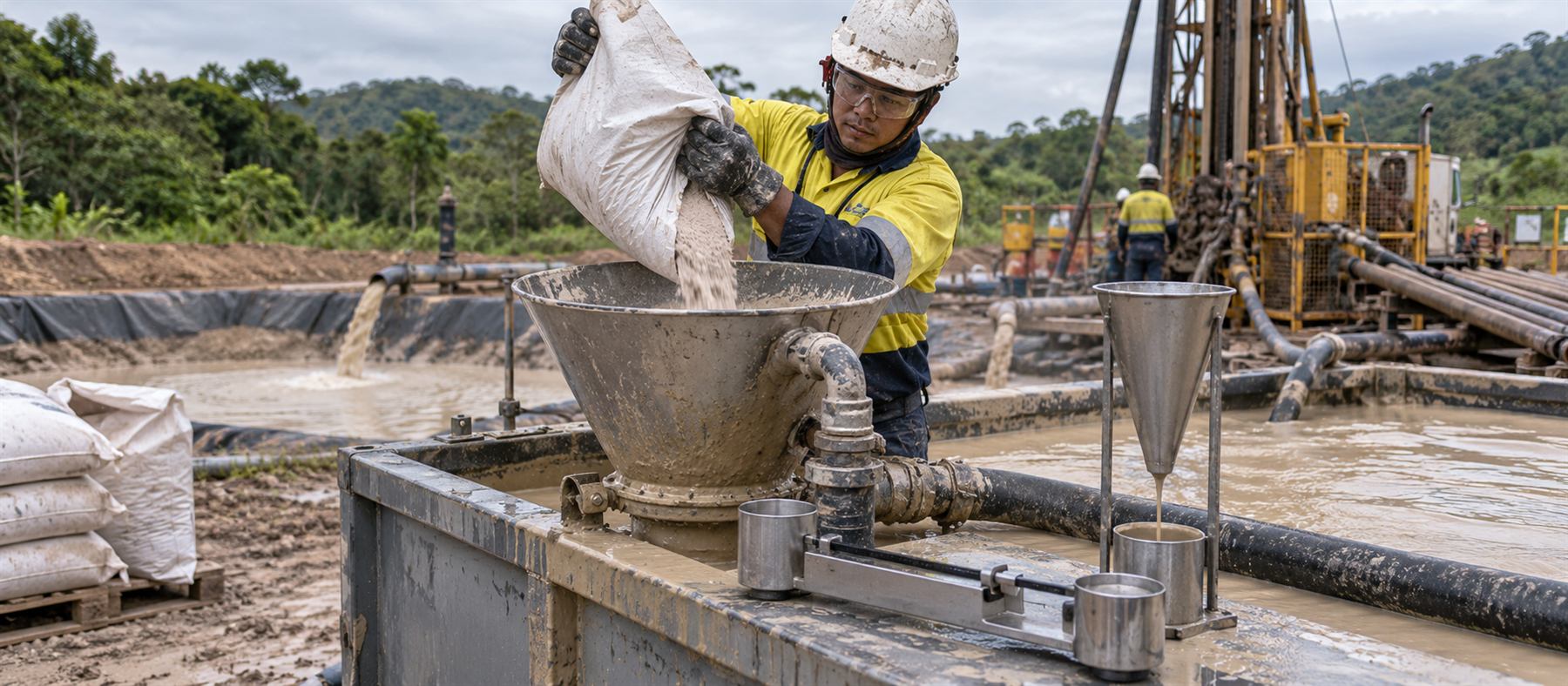
Ask two experienced drillers which base fluid to run and you will get two confident, opposite answers. Both are usually right about their own ground. The useful question is not which product is better — it is which physical problem the hole has, because bentonite and polymer solve different ones.
What each one physically does
Bentonite is a sodium montmorillonite clay. Mixed and hydrated properly it builds viscosity and, more importantly, deposits a thin, low-permeability filter cake against the wall of the hole. That cake is a physical membrane: it holds unconsolidated ground together and it stops fluid disappearing into permeable formations.
A polymer — usually a partially hydrolysed polyacrylamide in this application — does almost none of that. It builds viscosity for cuttings transport, it lubricates, and it encapsulates cuttings and coats reactive clay surfaces so they do not hydrate and swell. What it does not build is a filter cake.
The honest comparison
| Bentonite | Polymer | |
|---|---|---|
| Wall support | Strong — builds a filter cake | Weak — little to no cake |
| Shale and clay inhibition | Limited | Strong — this is what it is for |
| Mixing | Needs shear and hydration time | Mixes fast, hydrates in minutes |
| Solids loading | High; adds solids to the system by design | Low solids, easier on pumps and downhole tools |
| Effect on core | Can coat and mask the core surface | Cleaner core, easier logging |
| Disposal and sump volume | Larger volumes, heavier solids to manage | Lower volumes, can be broken down chemically |
| Cost per hole | Cheap per kilogram, used in quantity | Expensive per kilogram, used in small doses |
When you want bentonite
- Unconsolidated overburden — sand, gravel, alluvium — where nothing but a filter cake is holding the wall.
- Permeable, porous formations taking fluid, where sealing the wall is the whole objective.
- Water-well and large-diameter work where hole stability and cuttings suspension in a wide annulus dominate everything else.
- Any hole where you need the fluid column to exert real support and you are prepared to manage the solids that come with it.
When you want polymer
- Reactive shale, mudstone and swelling clay, where the problem is chemical rather than mechanical.
- Diamond coring, where low solids protect the pump, the bit and the core, and where a clean core face makes logging faster.
- Deep holes where torque and drag matter and lubricity earns its cost back in bit and rod life.
- Programs with tight environmental constraints on sump volume, or a requirement to break the fluid down before disposal.
Most real systems are both
A common working setup is a light bentonite base for wall support with polymer added for inhibition and lubricity — and a bentonite system that has been extended with polymer needs its properties measured, not assumed. Adding products to a mud without testing it is how a system ends up thick, expensive and doing neither job well.
Test the make-up water before you blame the product
Bentonite that will not yield is usually a water problem, not a bentonite problem. Hard water — calcium and magnesium — flocculates bentonite and stops it hydrating, and so does salinity. The result is a mud that needs twice the product to reach the same viscosity, which reads on the invoice as a bad batch.
- Check pH and hardness of the make-up water before mixing anything, on every new water source.
- Treat hard water with soda ash before adding bentonite, not after.
- Bring the pH up into the mildly alkaline range where bentonite hydrates properly, and check it again once the system is mixed.
- Give bentonite time to hydrate. A system mixed and pumped straight down the hole has not become mud yet.
- Re-test when the water source changes. A new creek or a new bore is a new fluid program.
Related in the catalogue