How-to
Setting up a drilling fluid program that holds the hole
Polymer selection, mix ratios, and reading returns on a struggling hole.
6 min read
Fluid is the cheapest part of the hole and the part most likely to lose it. This is how to build a program that stands the wall up, brings the cuttings out, and tells you what is going on down there — starting with the thing most programs get wrong before the first bag is opened.
Start with the water, not the additives
Every additive you are about to buy assumes something about the water it goes into. Bentonite will not yield properly in hard or brackish water. Polymers hydrate badly outside their pH window. If the make-up water is drawn from a creek, a bore or the sea-influenced coastal aquifer, it needs testing before anything is specified.
- Test hardness, pH and chlorides on the actual water source, not a nearby one.
- Treat calcium and magnesium out with soda ash before mixing anything else.
- Most bentonite and polymer systems want pH somewhere around 8.5 to 9.5. Get there first.
This is the step that gets skipped
A fluid program designed on the wrong water is a fluid program you will design twice — once in the office and again at 2 a.m. with a hole that is taking fluid and a crew waiting.
What each product is actually for
| Family | What it does | When to reach for it |
|---|---|---|
| Bentonite | Builds viscosity and lays down a filter cake that seals and supports the wall | Unconsolidated sand, gravel and weathered overburden |
| PHPA polymer | Encapsulates cuttings and inhibits reactive clays from swelling and dispersing | Swelling or sloughing shale, mudstone, weathered clay |
| PAC / CMC | Fluid-loss control — tightens the filter cake and slows filtrate invasion | Permeable ground, and anywhere filtrate is damaging the wall or the sample |
| Xanthan biopolymer | Shear-thinning viscosity: thick at rest in the annulus, thin at the bit | Hole cleaning at low pump rates, and where a filter cake is not wanted |
| Lubricants | Cut torque and rod wear | Deep, deviated or tight holes; anywhere rod RPM is high |
| Detergent / surfactant | Stops the bit balling up | Sticky clays |
| Lost circulation material | Bridges and plugs voids so fluid stays in the hole | Fractured, vuggy or cavernous ground; whenever returns go away |
| Barite | Weights the fluid up | Where hydrostatic head is needed to hold a pressured formation |
Mixing order, and why it matters
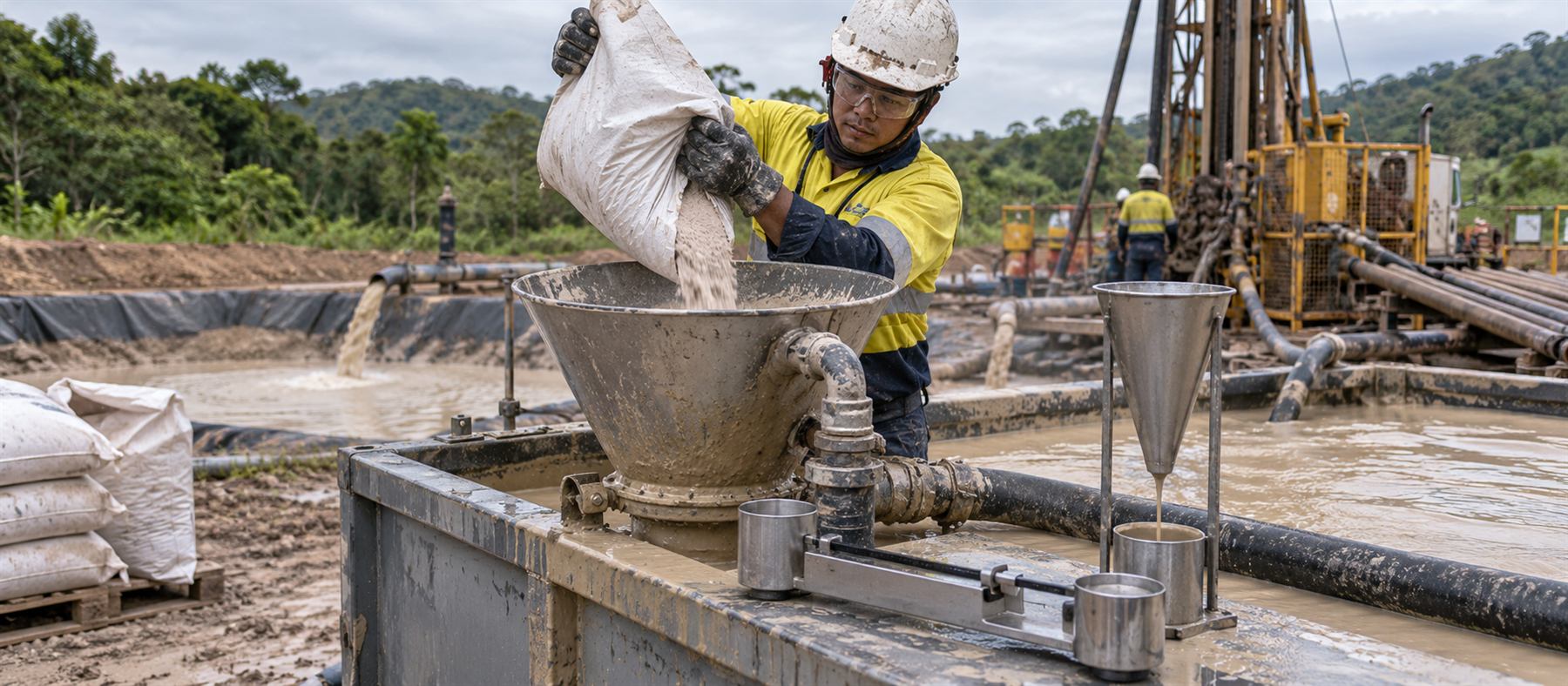
- Treat the water. Soda ash in first, and give it time to react before anything else goes in.
- Bentonite next, if the program uses it. It needs shear and it needs hydration time — a bentonite mud mixed and used immediately reads thin at the tank and then thickens in the hole, which is the worst of both.
- Polymers last, slowly, through a jet hopper or venturi. Tipped into the middle of a tank they fisheye: lumps with dry powder sealed inside that never yield, and later plug a screen at the worst moment.
- Let the system stand before you drill on it. Most of the complaints about a product not working are complaints about not waiting.
Housekeeping around the mixing station
Spilled polymer plus water is genuinely slippery — treat a wet mixing pad as a fall hazard and hose it down rather than leaving it. Follow the safety data sheet for handling and PPE on every product; dry powders and dust masks are not optional.
Four measurements worth the two minutes
A drilling fluid program with no measurements is a set of opinions. None of this kit is expensive and all of it fits in a crate.
| Test | Kit | What it tells you |
|---|---|---|
| Funnel viscosity | Marsh funnel and cup | Whether the fluid will carry cuttings. Clean water runs about 26 seconds per quart — anything you mix is read against that baseline and trended over the shift. |
| Density | Mud balance | Hydrostatic head, and solids build-up. Density climbing with no weighting agent added means you are drilling your own cuttings. |
| Sand content | Sand screen kit | The abrasive fraction that eats pumps, rods and bits. Keep it low; in diamond drilling, well under one per cent. |
| Fluid loss | API filter press | How well the wall is being sealed. Cake quality degrades here before it shows anywhere else. |
| pH | Strips or a meter | Whether the additives are in a range where they can work at all. |
Reading the returns
The returns are a live log of the hole. This is the table worth pinning up at the rig.
| What the hole is doing | Likely cause | First move |
|---|---|---|
| Returns stop | Fractured, vuggy or cavernous ground taking the fluid | Lost circulation material, staged coarse to fine. If it keeps taking, case it rather than pumping the budget into the ground. |
| Returns thickening; rod torque climbing | Clay dispersing into the fluid | Inhibitor and dilution. Check that solids are actually being removed rather than recirculated. |
| Grit in the returns, sand settling in the sump | Hole cleaning is marginal | Raise annular velocity or viscosity, and clean the sump out. |
| Cuttings coming back rounded instead of angular | Cuttings are being re-ground downhole because they are not clearing | Same fix as above, and treat it as urgent — this is how a hole packs off. |
| Overpull on trips; hole packing off | Cuttings bed, or the wall is coming in | Ream and circulate clean before pulling. Then reassess inhibition, not just viscosity. |
| Filtrate thin and watery, no cake forming | No fluid-loss control in the system | PAC or CMC. |
| Fluid loss creeping up across a shift | Cake breaking down — solids loading or contamination | Check pH and hardness first; contamination is more often the cause than dosage. |
Starting points by ground type
| Ground | Where to start |
|---|---|
| Competent hard rock | Clear water plus a lubricant, and a trace of polymer for rod torque |
| Broken and fractured | Xanthan for carrying capacity, with lost circulation material staged and ready |
| Reactive shale and clay | Soda-ash-treated water, PHPA inhibitor, PAC for fluid loss |
| Unconsolidated sand and gravel | Bentonite for cake and wall support, PAC to tighten it |
These are starting points, not recipes
Concentrations belong to the product data sheet and to the hole in front of you. Mix to the sheet, measure, and adjust on what the returns and the funnel tell you — a number carried over from a different program on a different water source is a coincidence, not a specification.
The sump does half the work
Solids control is unglamorous and it is where most of the additive budget is actually saved. A well-built sump removes what the fluid picked up so the fluid can go back down and pick up more.
- Size the sump for settling time, and run it as more than one cell so the fluid has somewhere to drop its load.
- Never recirculate sand. It costs you a pump, then a rod string, then a bit, in that order.
- Dilute rather than stacking additives on top of a tired system. Adding product to fix a solids problem makes a more expensive solids problem.
- Plan the disposal before the program starts — where the sump goes at the end is a permitting question, not a demobilisation question.