Maintenance
Ground support consumables: when to replace, not repair
Inspection intervals for friction bolts, plates, and mesh underground.
5 min read
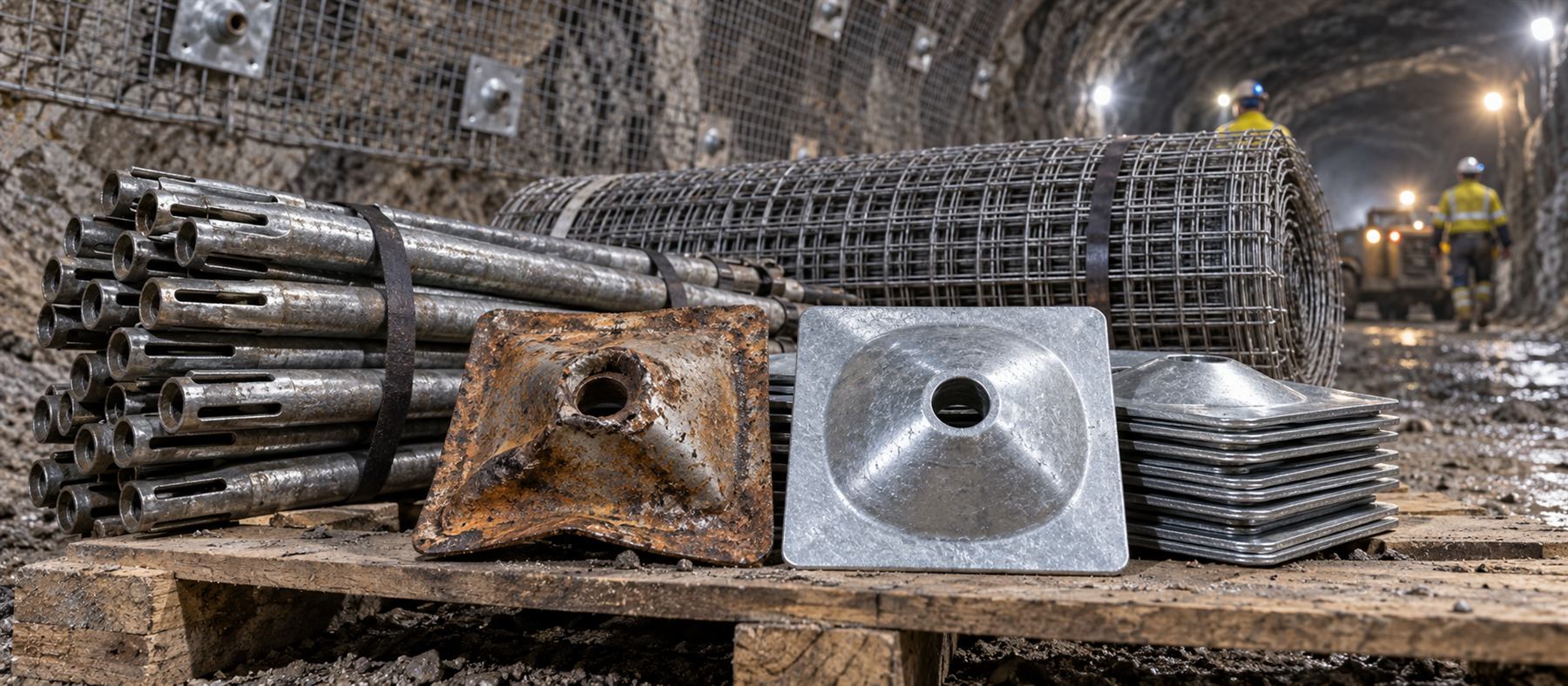
Ground support is a consumable system with a service life, and rehabilitation is a planned activity rather than an admission that something went wrong. What follows is background for the people specifying, ordering and inspecting the consumables — written for the supply side of the decision.
This does not replace your ground control management plan
Ground support design, inspection frequency and rehabilitation triggers are set by the mine’s ground control management plan, its geotechnical engineer and the regulator. Where anything here differs from that plan, the plan governs. Nothing on this page is an engineering standard or a substitute for a competent person’s assessment underground.
The short answer: load-bearing elements get replaced
The question in the title has a blunt answer for almost every element of a support system. Bolts, plates, mesh and straps are engineered consumables. Once one has been damaged or has taken load, it is replaced with the same specification — not restored.
- Do not straighten a bent plate and put it back. It has already yielded; the capacity you are counting on is the capacity it no longer has.
- Do not weld, heat or cut a bolt to reuse it. Heat changes the properties of the steel, and the change is invisible from the outside.
- Do not lace over a failed mesh sheet and call it repaired. Lacing is a legitimate technique in its own right, but it is not a patch for a sheet that has already torn.
- Do replace like for like against what was designed and installed. A substitution underground is a design change, and it belongs with the engineer, not with the storeman.
What to look for
| Element | What you are looking for | What it is telling you |
|---|---|---|
| Friction bolts | Rust bleeding at the collar, a plate that is loose or spins by hand, a bolt standing further out of the hole than it was installed | Corrosion, or ground movement pushing the bolt out. Both are replace-and-reassess, not tighten-and-move-on. |
| Plates | Coning beyond the design shape, cracks radiating from the hole, a plate no longer sitting flush against the rock | The plate has taken load. Load taken is capacity the system no longer has in reserve. |
| Mesh | Broken strands, sagging pockets holding loose rock, tears at the overlaps, corrosion at cut ends | Cut ends corrode first because that is where the galvanising stops. That is where a sheet fails. |
| Resin and cable bolts | Corrosion on exposed strand, damaged barrel and wedge, resin not filling to the collar | Anchorage is unverified. It gets tested before it gets trusted. |
| Shotcrete | Map cracking, spalling at the toe, drummy areas when sounded | Movement behind the liner. The liner is reporting on the rock, not on itself. |
What actually sets the replacement interval
There is no catalogue number for this, and any supplier who gives you one without seeing the ground is guessing. The interval is a function of the environment the support is sitting in.
- Corrosivity: water chemistry, salinity, humidity and ventilation. A warm, wet, poorly ventilated drive will corrode black steel dramatically faster than a dry one — which is the normal operating condition for most underground work in this region.
- Whether the element is galvanised or black, and whether the galvanising survived installation.
- Stress and seismicity. Dynamic ground needs support rated for dynamic loading, and it degrades on a completely different clock from static support.
- The design life of the excavation. Support for a two-year decline is not the same specification as support for a twenty-year main access.
- What the monitoring says: extensometers, convergence measurement, and the results of pull testing.
Sacrificial test bolts turn guesswork into a rate
Install a small number of extra bolts at the start of a campaign specifically to be pulled and destructively examined on a schedule. Over a couple of years they give you a measured corrosion and capacity-loss rate for your ground and your water, which is worth more than any published table.
Inspection cadence
Frequencies are set by statute and by the ground control management plan. The structure they almost always take is three tiers.
- Every shift, by the crew, in every travelled way: a visual scan for new loose, new water, and plates that have moved since the last pass.
- Formal periodic inspection by a competent person, at the frequency the plan sets, recorded and trended rather than just signed off.
- Trigger-based inspection: after a seismic event, after a nearby blast, after significant water inflow, and after any observed movement — regardless of when the last scheduled inspection was.
The part that lands on the supply office
- Stock replacements that match what is installed. Mixing bolt lengths, plate sizes or thread types across a mine creates a compatibility problem that is discovered underground, at the worst possible time.
- Carry rehabilitation stock, not just development stock. The unplanned replacement is the one that stops the job.
- Store galvanised and black steel separately, off the ground and out of the rain. Consumables that corrode in the yard were bought twice.
- Check consignments against specification on arrival — bolt length, plate thickness, mesh gauge and aperture — not just the count on the delivery note.
Related in the catalogue