Buying guide
BQ, NQ, HQ, PQ: choosing a core size and living with it
Core and hole diameters for the standard wireline sizes, and the trade-offs that should decide which one you drill.
4 min read
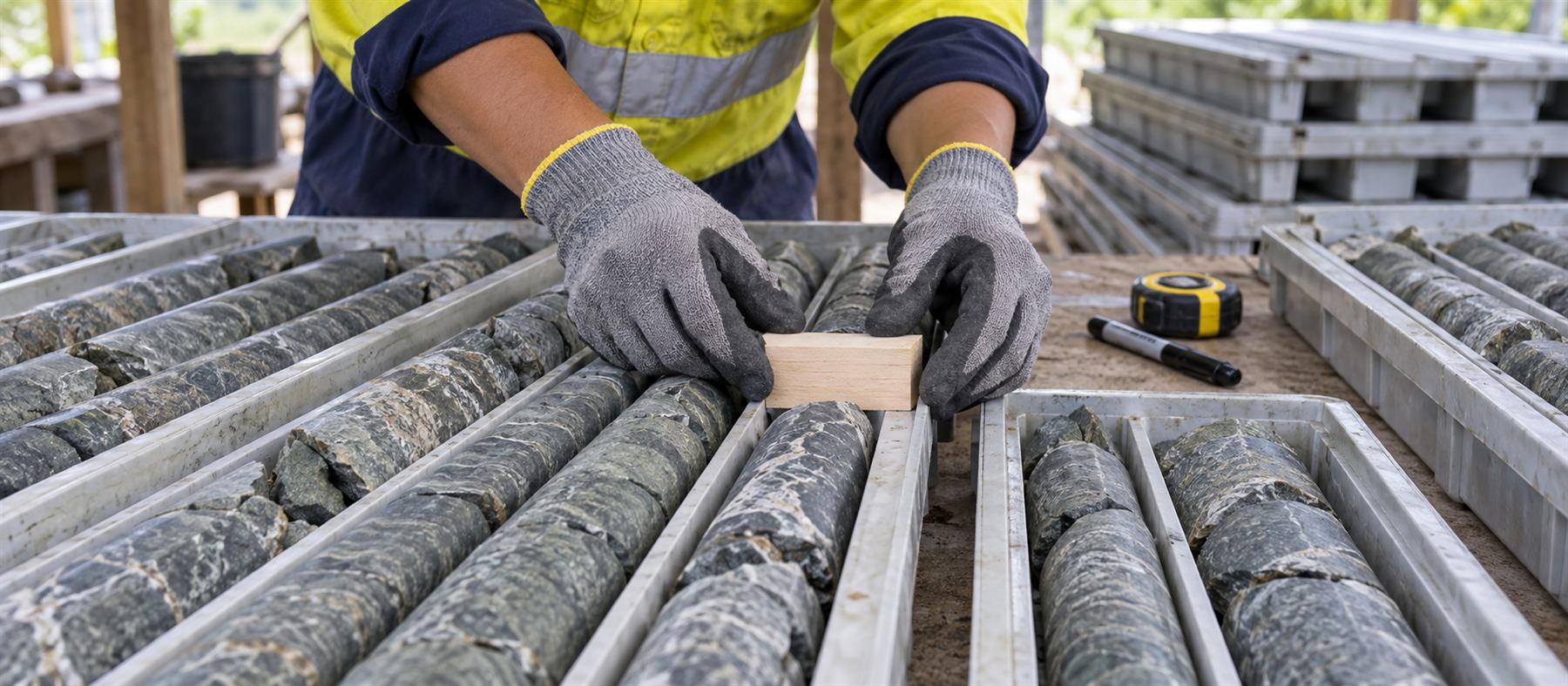
Core size is the most consequential single decision on an exploration program and the one most often inherited rather than made. It sets your sample mass, your depth capability, your rig requirement, your consumable spend and your core shed footprint — all at once, and all before the first metre is drilled.
The numbers, in one place
These are the standard wireline sizes. Core diameter is what ends up in the tray; hole diameter is what the bit cuts and therefore what the next casing string has to pass through.
| Size | Core diameter | Hole diameter | Typical use |
|---|---|---|---|
| AQ | 27.0 mm | 48.0 mm | Rare in mineral work; shallow, small-rig or grade-control holes |
| BQ | 36.4 mm | 60.0 mm | Deep holes where the rig is size-limited, and underground drilling |
| NQ | 47.6 mm | 75.7 mm | The default for most surface exploration in the Philippines |
| HQ | 63.5 mm | 96.0 mm | Resource definition, geotechnical and metallurgical sampling |
| PQ | 85.0 mm | 122.6 mm | Bulk metallurgical samples, geotechnical, very broken ground |
Triple tube changes the core diameter, not the hole
NQ3, HQ3 and PQ3 run a split inner tube inside the same hole size, which costs you a few millimetres of core — HQ3 recovers about 61 mm against HQ’s 63.5 mm. You give up sample mass and gain core that arrives in the tray in the order and orientation it came out of the ground.
Sample mass scales with the square of diameter
This is the reason a bigger size is not merely nicer. HQ core has roughly 1.8 times the cross-sectional area of NQ, and PQ roughly 3.2 times. For a nuggety gold deposit, a coarse-grained system or anything where the assay variance is driven by sample size, that is not a marginal improvement — it is the difference between a resource that stands up and one that does not.
It is also the reason metallurgical and geotechnical holes are so often drilled a size up from the surrounding resource holes. Those programs need mass and intact lengths, and no amount of care in the shed recovers what the diameter never sampled.
What every step up actually costs
- Depth. A larger string is heavier, has more annular contact and more torque demand. The same rig that reaches 700 metres in NQ may struggle past 400 in HQ.
- Fluid. A PQ hole has more than twice the annular volume of an NQ hole per metre, so mud volumes, additive consumption and sump capacity all rise with it.
- Consumables. Bits, reaming shells, core lifters and rods all cost more in the larger series, and the metres per bit do not improve to compensate.
- Handling. HQ and PQ core is heavy. Trays fill faster, the shed racking carries more load, and the crew lifting it does so all shift.
- Casing. Every size you may need to telescope down to has to be planned from the collar. You cannot decide at 150 metres that you would rather have started bigger.
Plan the telescope before you collar
If there is any chance the hole will need to be cased off and reduced — bad ground, water, a lost zone — the size you collar in has to leave room for it. The standard progression drops one size at each step: collar PQ or HW casing, drill HQ, case with HW, drop to NQ, and so on down.
A hole collared in NQ with no room to reduce has exactly one option when it starts caving, and that option is abandoning it. Deciding to start a size larger costs a few per cent on the program and buys the whole program an escape route.
The honest default
For most greenfield and brownfield surface exploration in this region, NQ is the right answer: enough sample for reliable assays, enough depth for the target, and consumable costs the program can carry. Step up to HQ when the assay variance, the geotechnical logging or the metallurgical requirement justifies it. Step down to BQ when depth or an underground rig makes it necessary, and accept the smaller sample knowingly rather than by default.
Do not change size mid-program without recording it
A dataset that mixes NQ and HQ intervals without flagging them is a dataset with an undocumented sampling bias in it. Whatever you drill, make the size a logged field, not something reconstructed later from the drilling contractor’s invoices.
Related in the catalogue