How-to
Designing a casing program for unstable ground
How to plan the telescope before you collar, and what it costs when the hole decides for you at 150 metres.
4 min read
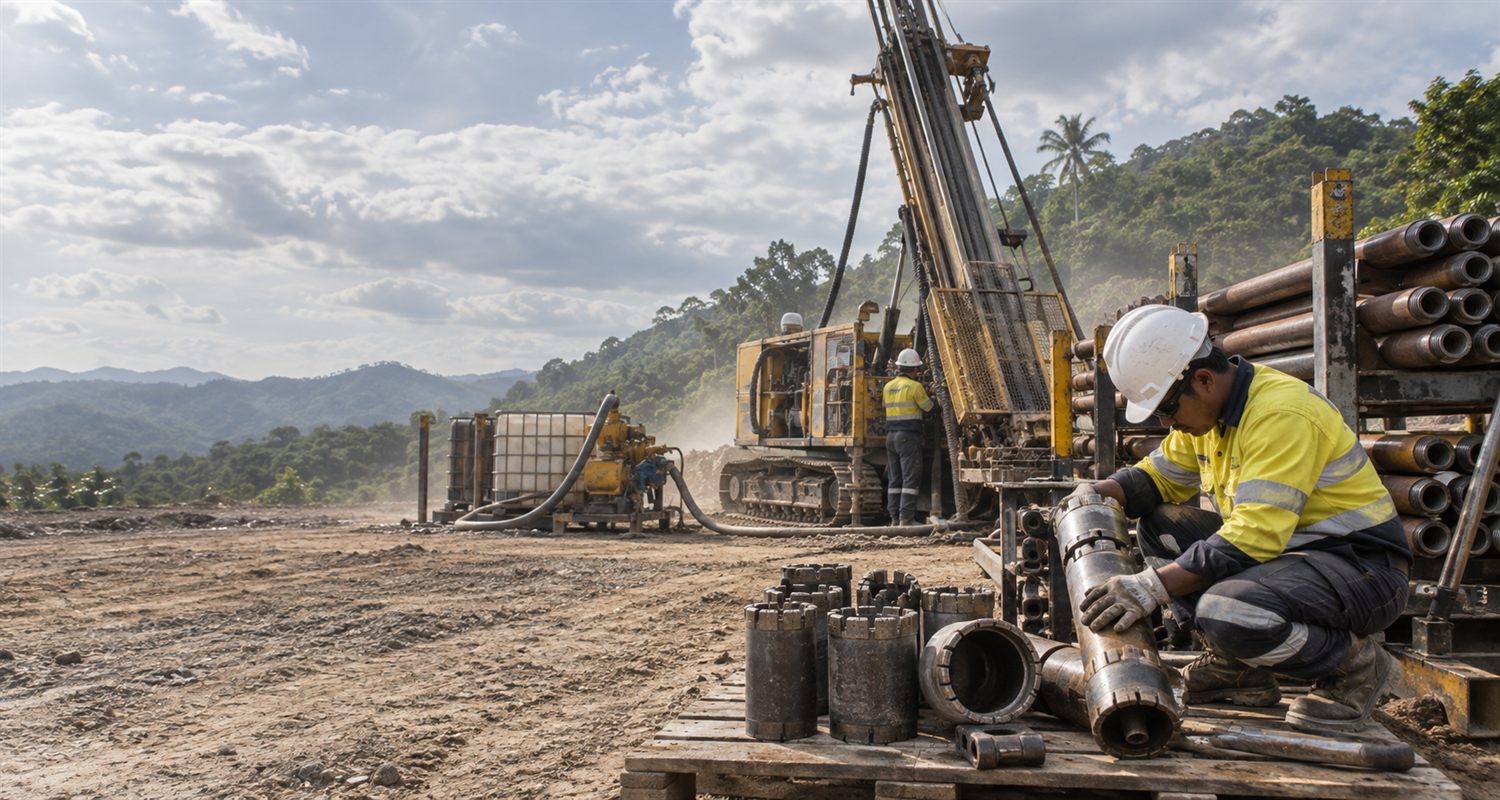
Casing is the least interesting line on a drilling budget and the one that most often decides whether a hole reaches target depth. In the deeply weathered profiles common across the Philippines, a casing program is not contingency — it is the plan, and it has to exist before the collar is drilled.
What casing is actually doing
- Holding the wall of the hole open where the formation will not hold itself — saprolite, sand, gravel, fault gouge, broken and blocky ground.
- Isolating a zone that is stealing your circulation, so you can drill ahead below it with returns.
- Keeping water out of the hole, or keeping the hole out of an aquifer you are required not to connect.
- Giving the rod string a smooth, straight path through the part of the hole most likely to be crooked, which is the top of it.
Plan the telescope from the bottom up
The mistake is planning forward from the collar. Plan backwards: decide what size you need at target depth, then add a casing string for every zone you expect to have to case off, and let that arithmetic tell you what size to collar.
A conventional progression drops one size per step — collar with HW casing and drill HQ, then set NW and drill NQ, then set BW and drill BQ. Each string you plan for is a size you have to start bigger to afford.
You cannot add a step you did not plan for
A hole collared NQ that starts caving at 150 metres has no size left to reduce into. The options are a cement plug and a wedge, or abandoning the hole and re-collaring — both of which cost more than starting one size larger would have.
Reading the ground before you drill it
Most of what you need is already available. Nearby holes, the weathering profile, the regional geology and the crew who drilled the last program will between them tell you where the bad ground sits and roughly how thick it is.
- Depth to fresh rock, from adjacent holes. In a tropical profile this is often the single largest casing decision on the hole.
- Known fault and shear zones on the section, and where the hole intersects them.
- Water table depth, and whether there is a perched aquifer above it.
- Historic workings, old drill holes and voids, which are lost-circulation zones with a fixed address.
Setting a string so it does its job
- Land the shoe in competent ground below the problem zone, not level with it. A shoe set in the same broken material it is meant to case off will not seal and will not stay put.
- Ream the interval to full gauge before running casing. Casing forced down an under-gauge hole is casing you will not get back.
- Grout or cement the annulus where you need a hydraulic seal, not just mechanical support — particularly around a water zone you must isolate.
- Let cement set properly before drilling out. The metres you save by drilling a green plug are metres you lose when the plug fails.
- Record the shoe depth and casing size in the drill log the moment it is set, not from memory at end of shift.
Fluid does half the work casing gets credit for
A properly designed drilling fluid holds far more hole open than most programs realise. A bentonite system building a filter cake across a permeable zone, or a polymer system inhibiting a reactive clay, can carry an interval that would otherwise need a string of casing.
That is the cheaper of the two answers, and it should be exhausted first. Casing is what you set when the ground will not hold with any fluid you can reasonably run.
The part that lands on the supply office
- Stock casing to a plan, not to a request. The moment casing is needed, it is needed at the rig within hours — a two-week lead time is a two-week standdown.
- Match casing shoes, couplings and threads to the string actually on site. Mixed thread forms across a yard get discovered in the middle of the night.
- Hold enough of the next size down. A single string of the right casing rescues a hole; a full pallet of the wrong size does nothing.
- Store it off the ground and out of the weather. Casing rusted into a stack is casing that does not run.
Related in the catalogue