Buying guide
Downhole surveying: magnetic tools, gyros, and when each one is valid
A magnetic survey in magnetite or inside casing is not a slightly worse survey. It is a wrong one.
4 min read
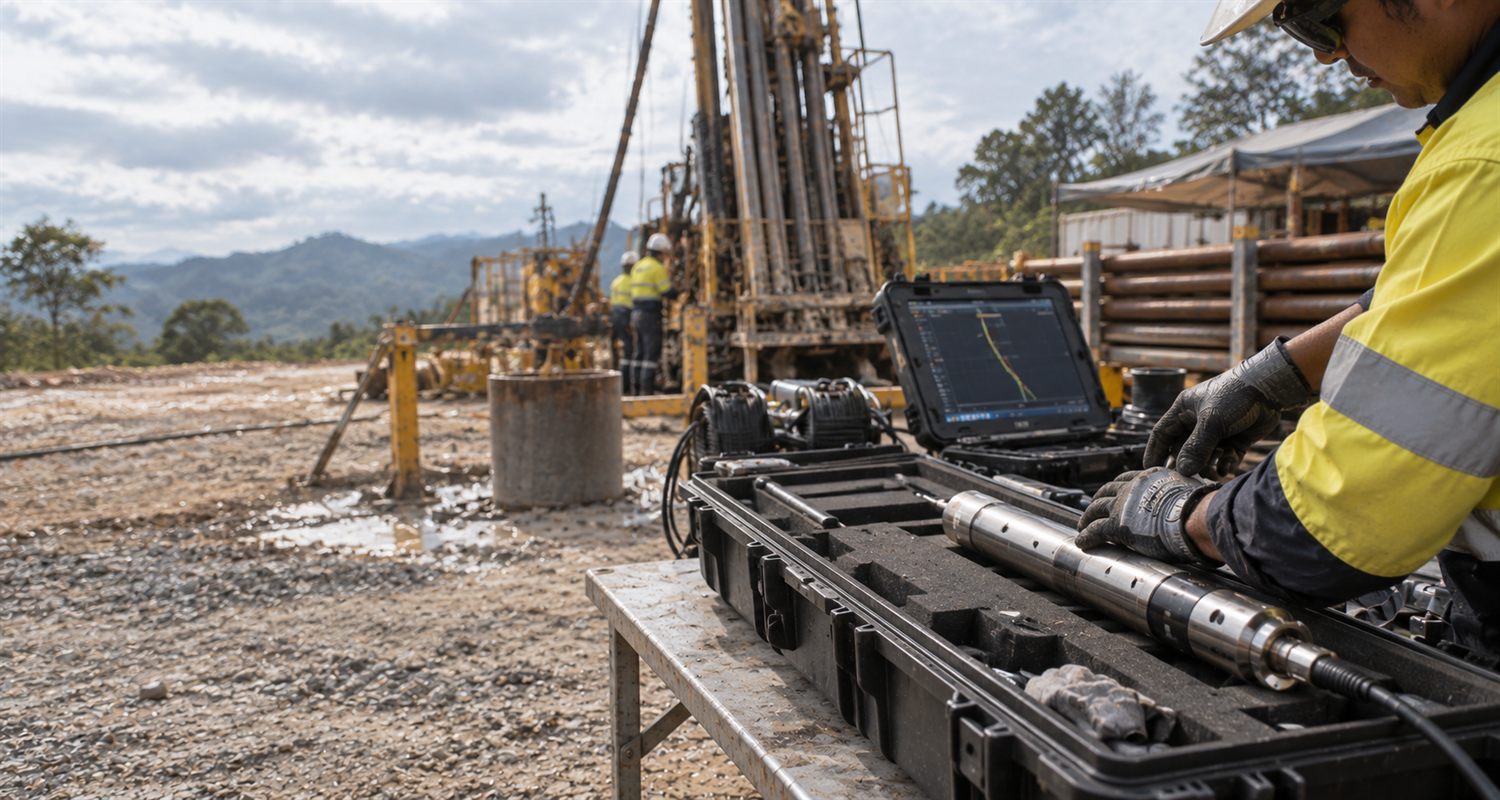
Every hole deviates. The question is whether you know where it went, and a surprising number of programs answer that question with a tool that cannot physically produce a valid answer in the ground being drilled. This is the difference between the tool types, and the conditions that rule each of them out.
Why the position matters more than the depth
A hole planned at 300 metres and 60 degrees can arrive tens of metres from where the section says it is. Every assay in that hole then sits at the wrong coordinate in the model, the interpolation between holes is wrong, and the error is invisible because the data all looks perfectly reasonable.
Downhole surveying is the cheapest quality control on a drilling program after core photography, and it is the one most often reduced to a single collar reading to save money.
Magnetic tools: single-shot and multishot
A magnetic tool measures the Earth’s magnetic field to get azimuth and gravity to get dip. It is inexpensive, robust, quick to run, and the standard workhorse on most exploration programs.
It is also completely invalid anywhere the local magnetic field is not the Earth’s. That includes inside steel casing, inside the rod string, near the bottom-hole assembly, and — critically for mineral exploration — in magnetite-bearing or pyrrhotite-bearing rock, which is exactly where a lot of orebodies are.
A magnetic survey in magnetic ground is not noisy, it is wrong
The failure mode is not scatter you can average out. It is a systematic azimuth shift that looks like a perfectly smooth, plausible hole trace. If the deposit contains magnetite, pyrrhotite, or a significant magnetic alteration halo, magnetic surveys through that interval have to be discarded, not down-weighted.
Gyroscopic tools
- A north-seeking gyro finds true north from the Earth’s rotation, so magnetic rocks and steel do not affect it. It can be run inside casing and inside the rod string, which is what makes it the only option for surveying a cased pre-collar.
- A continuous gyro is run in and out and logs the whole trace rather than a set of stations, giving a far denser picture of where the hole actually went — which is what you need for a dogleg problem or an intersection that has to be hit.
- MEMS-based tools have made gyro surveying cheaper and more portable than it was, and the gap in cost between magnetic and gyro is now much narrower than most programs assume.
- Gyros need care: alignment, calibration and temperature stability all matter, and they do not tolerate being dropped the way a magnetic tool does.
Choosing between them
| Condition | Magnetic | Gyro |
|---|---|---|
| Non-magnetic host rock, open hole | Valid and economical | Valid, usually unnecessary |
| Magnetite, pyrrhotite or magnetic alteration | Invalid | Required |
| Inside steel casing or rod string | Invalid | Required |
| Underground, near steel support and services | Unreliable | Required |
| High-precision intersection or directional work | Insufficient | Continuous gyro |
| Routine grade-control holes in clean ground | Appropriate | Overspecified |
Running a survey properly
- Survey at a fixed interval — commonly every 30 metres, tighter where the hole is bending — and always at the collar and at total depth.
- Take the station with the string stationary and let the tool settle. A reading taken while the string is moving is noise.
- Repeat a station now and then as a check, and repeat it on the way out as well as the way in. Disagreement between in-run and out-run readings is the earliest warning that something is wrong.
- Record the tool, the serial number, the operator and the time with every station, so a bad tool can be traced through the dataset later.
- Get the collar right. A precise downhole trace hung off a hand-held GPS collar position is precise nonsense.
And then do something about the deviation
Surveying tells you the hole is bending. It does not stop it. Deviation is driven by the collar set-up, the bottom-hole assembly stiffness, the weight on bit, and the foliation or bedding of the rock the bit is trying to cut across.
If the survey shows a consistent drift in one direction, that is a mechanical problem with a mechanical answer — stiffer assembly, reamers, less weight, a different collar angle — and it is worth fixing on hole two rather than living with it for the whole program.
Related in the catalogue