How-to
Cutting core cleanly: choosing and running diamond saw blades
Blade bond follows the same backwards rule as a drill bit, and a badly cut half is a sampling error nobody logs.
4 min read
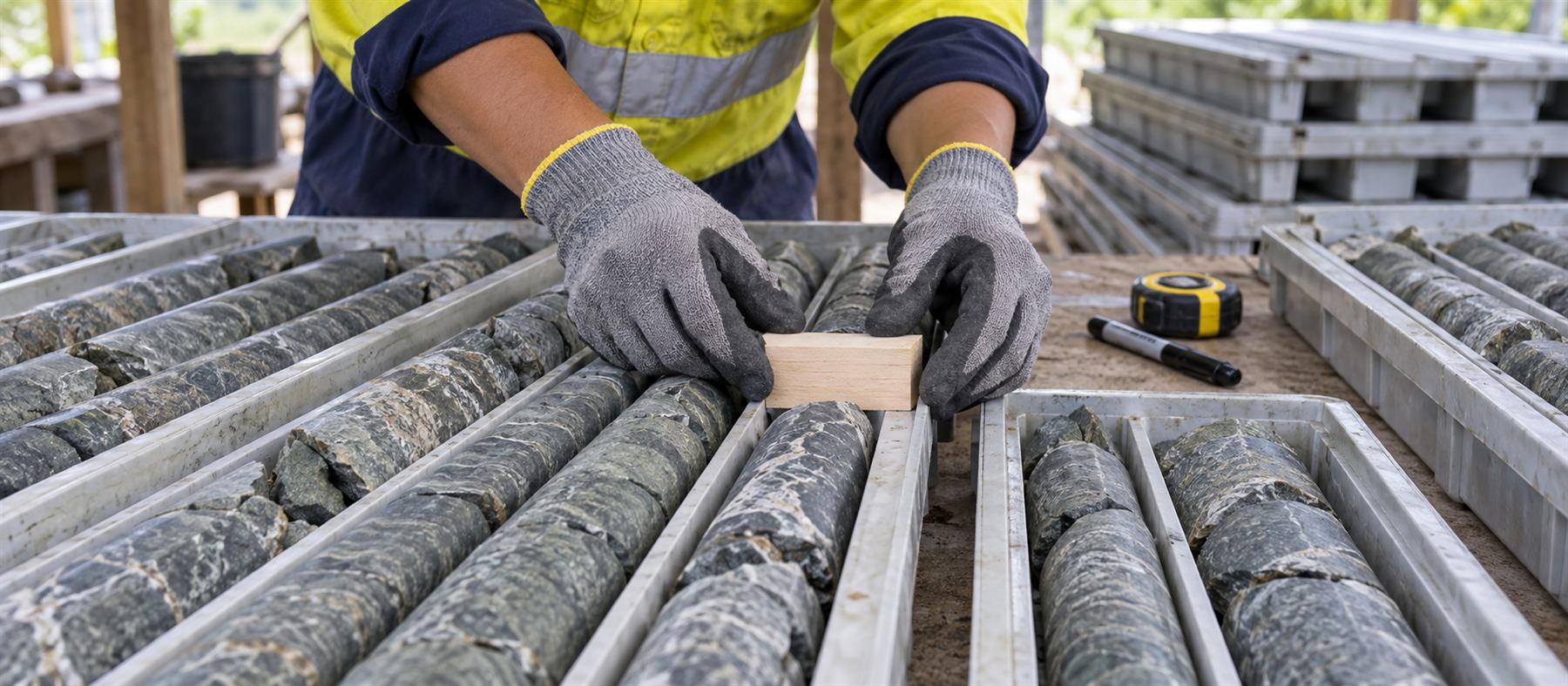
Core cutting is treated as a chore between logging and dispatch, which is why it is where a surprising amount of sampling error is introduced. The saw decides which half goes to the laboratory, and if the cut wanders, the half that gets assayed is not the half the geologist logged.
Bond hardness runs backwards, exactly like a drill bit
A diamond saw blade cuts the same way an impregnated core bit does: the diamond has to be continually exposed by the bond wearing away. So the rule is the same and it is just as counter-intuitive.
- Hard, non-abrasive rock wants a soft bond, because the rock will not wear the bond back on its own and a hard bond will simply glaze over and stop cutting.
- Soft, abrasive rock wants a hard bond, because abrasive material strips the bond away and takes the diamond with it long before it has done its work.
- A blade that has glazed can usually be re-opened by running it through an abrasive dressing block — the same trick as sharpening a polished core bit.
- A blade losing segments or wearing visibly faster each shift is too soft for what it is cutting, or is being run too fast, or is starved of water.
Segmented, turbo or continuous rim
| Rim type | Cut quality | Best for |
|---|---|---|
| Segmented | Fastest, roughest edge | Production cutting of competent, hard core where speed matters most |
| Turbo | Fast, moderately clean | General-purpose core cutting across mixed lithologies |
| Continuous rim | Slowest, cleanest edge | Friable, fractured or soft core that chips at the cut, and any core being photographed after cutting |
Running the saw
- Cut wet, always. Water cools the blade, clears the kerf and — the reason that matters most — controls the silica dust that dry-cutting rock produces.
- Check the water is reaching both faces of the blade, not just spraying near it. Uneven cooling warps blades.
- Let the blade do the work. Forcing the feed heats the blade, glazes it and pushes the cut off line.
- Support the core through the cut. An unsupported piece pinches the blade at the end of the cut, which is where blades crack and where core snaps.
- Run at the blade’s rated speed. Over-speeding a blade shortens its life and is the main mechanical hazard on the saw.
Dry cutting is a respiratory hazard, not just a wear problem
Cutting silica-bearing rock dry generates respirable crystalline silica. Wet cutting, local extraction and appropriate respiratory protection are not optional, and this note does not replace the site’s own occupational hygiene controls.
Where the cut goes is a sampling decision
The blade line has to be planned against the orientation mark, not against whatever is convenient. If the core is oriented, the cut is conventionally made at a fixed relationship to the bottom-of-hole line so that the half sent for assay and the half retained are comparable across the whole program.
- Cut on the same side of the orientation line every time. A program that switches sides halfway through has introduced a bias that cannot be corrected afterwards.
- In strongly veined or banded core, an inconsistent cut line splits the vein unevenly and biases the assay. This is the mechanism behind a lot of otherwise unexplained duplicate mismatch.
- Keep the retained half in the tray, in order, with the depth blocks intact. It is the only physical record left of the interval.
- Photograph the tray before cutting, not after. After cutting the wet, flat face photographs better but no longer shows what was logged.
Housekeeping around the saw
- Clean the bed and the trough between samples. Fines carried from one sample into the next is contamination, and it is contamination that runs downhole in the direction you are cutting.
- Change the water often enough that the recirculating tank is not a slurry of the last twenty samples.
- Keep a spare blade on site. A saw with no blade stops core dispatch, which stops assays, which stops the program.
- Log blade changes against metres cut. It is the only way to tell whether a cheaper blade is actually cheaper.
Related in the catalogue