Field notes
Four mud tests worth doing every shift
Funnel, balance, sand content and pH. Twenty minutes a shift, and they catch almost everything before it becomes a stuck string.
4 min read
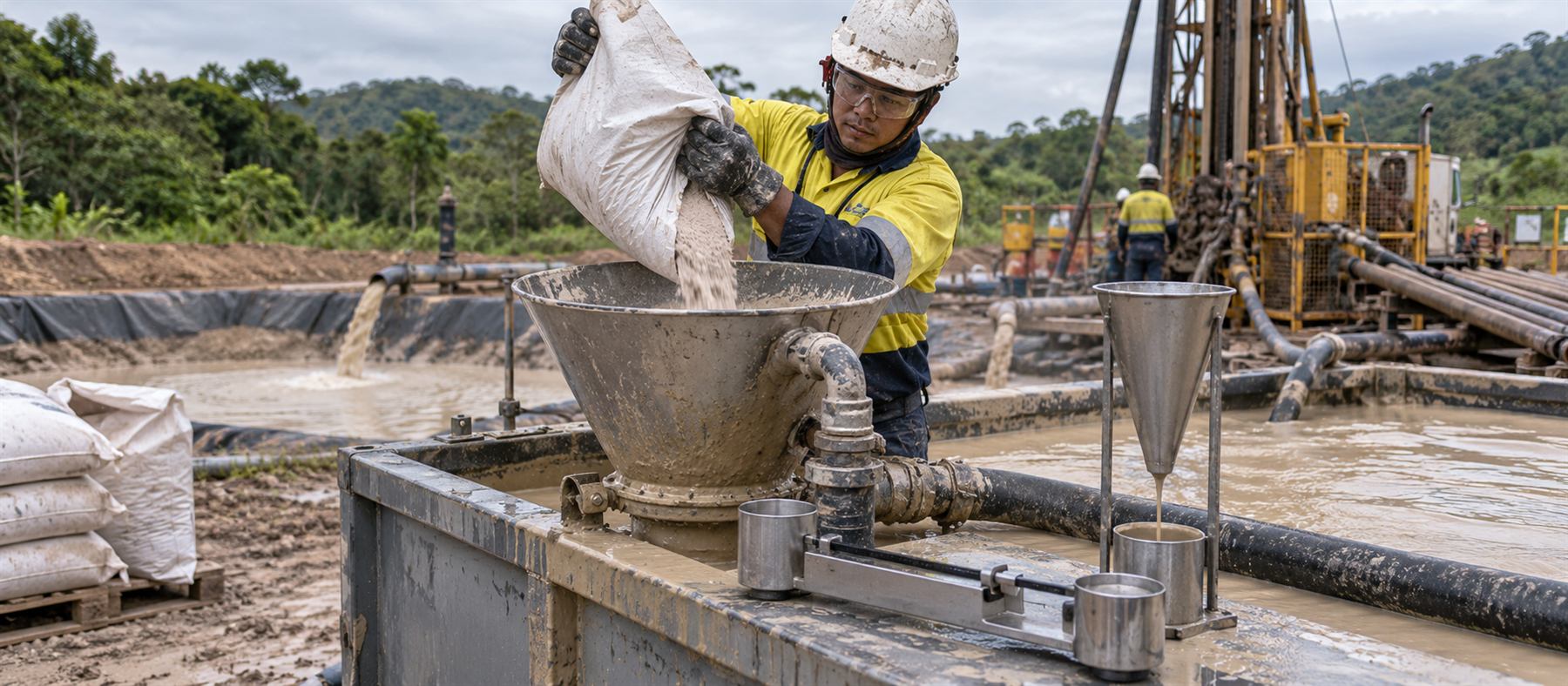
A drilling fluid program that is not measured is not a program, it is a habit. The four tests below need a funnel, a balance, a sand kit and a pH strip; they take about twenty minutes between them; and together they catch the great majority of fluid problems while they are still cheap to fix.
1. Marsh funnel viscosity
Fill the funnel to the screen with 1500 mL of mud, and time how long it takes to run one quart — 946 mL — into the cup. That time in seconds is the funnel viscosity. Clean water at around 21 degrees is 26 seconds, and every reading you take is relative to that.
- Take it from the same place every time — usually the suction, and a second reading from the return if you want to see what the hole is doing to the fluid.
- A rising trend at the return with a steady suction reading means the hole is loading the system with solids.
- Too thin and cuttings are not being carried; too thick and you are pumping against yourself, packing off the annulus and raising the pressure the formation sees.
- Record it as a number in a shift log. The value of this test is entirely in the trend.
2. Mud density, on a balance
Density tells you what the fluid column weighs, which is what holds the hole open and what can break it. It also tells you how many solids you have picked up, because a mud that has gained weight without anyone adding weighting material has gained drilled solids.
- Level and calibrate the balance with clean water before you trust it. An uncalibrated balance is worse than no reading.
- Fill it properly and cap it without trapping air. Air in the cup reads as low density and hides a solids problem.
- Track it alongside funnel viscosity. Rising viscosity with rising density is drilled solids; rising viscosity with flat density is chemistry.
3. Sand content
This is the test most often skipped and the one that most directly protects your equipment. Sand is abrasive, and everything it passes through — pump liners, swivels, rod threads, bit waterways — wears in proportion to how much of it is circulating.
The kit is a sieve, a funnel and a graduated tube, it takes two minutes, and it reads directly as a percentage by volume. Keep it low; a system running visibly sandy is a system quietly rebuilding your mud pump.
Solids control beats solids treatment
The cheapest way to keep sand content down is to let the sump do its job — adequate settling volume, sensible baffling, and cleaning it out before it fills. No amount of product removes solids that a properly designed sump would have dropped out on its own.
4. pH
- Bentonite hydrates properly in mildly alkaline water. Mix it acidic and it will not yield, and the response — more bentonite — makes the system worse and more expensive at the same time.
- A falling pH through the shift usually means the formation is contaminating the system: acidic groundwater, sulphides, or cement being drilled out.
- Rising pH after drilling out a cement plug is normal, and it will affect how your polymer behaves until it settles.
- Strips are adequate for field use. The number matters less than noticing when it moves.
Write it down or do not bother
Each of these tests is nearly useless as a single reading and extremely useful as a series. A shift log with four columns and a line per test round turns fluid management from opinion into evidence, and it is the only way to answer the question that always comes up later: what changed?
- Test at the start of the shift, mid-shift and before handover, plus any time the hole behaves differently.
- Log the make-up water source alongside the readings; changing water source changes everything downstream.
- Log every product addition with the quantity and the time, so a property change can be attributed.
- Hand the log over with the rig, not at the end of the program. The next crew needs the trend more than the office does.
Related in the catalogue