Maintenance
Rod grease, thread compound and hammer oil: small spend, big consequences
Three cheap consumables that decide the service life of three expensive ones. Most sites get at least one of them wrong.
4 min read
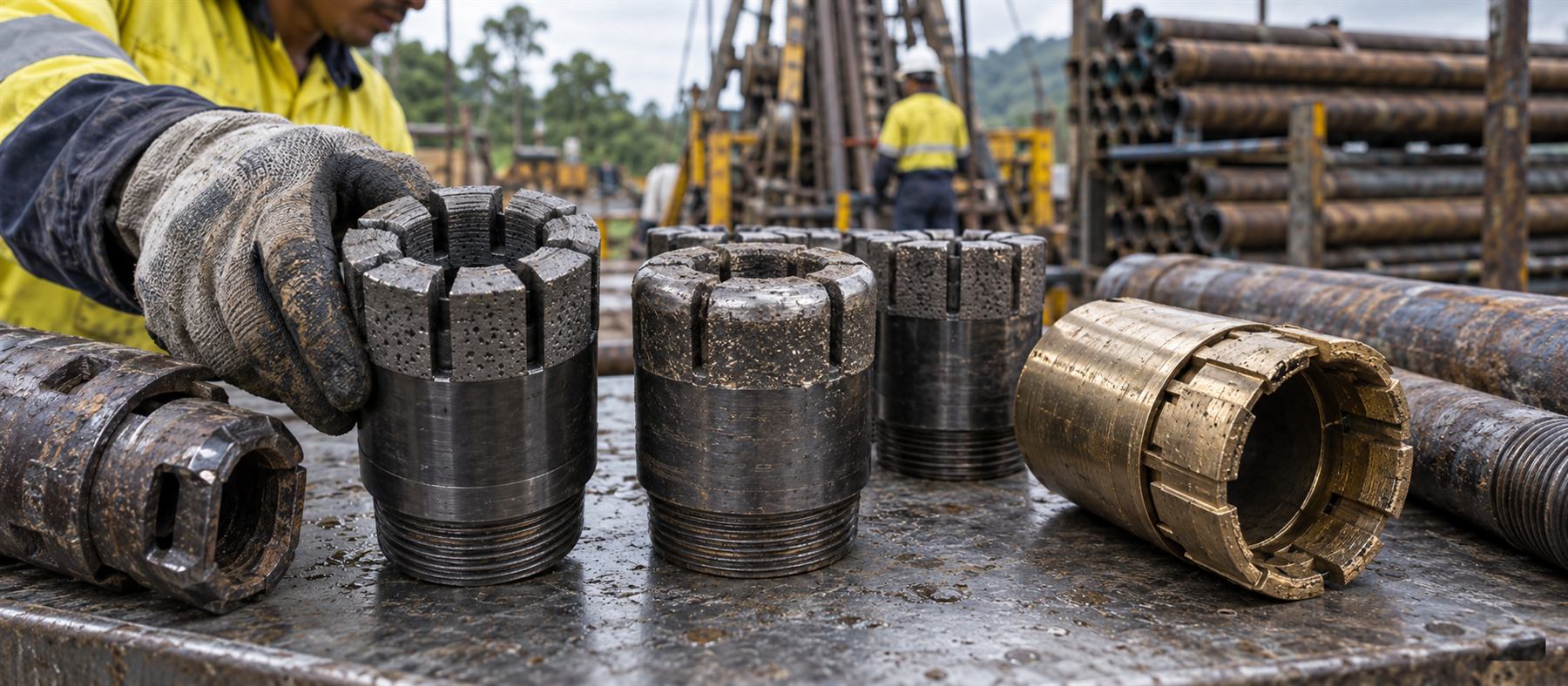
Lubricants are the smallest line on a consumables order and they sit directly upstream of the largest ones. A drum of the wrong oil will quietly consume a hammer; a habit of over-greasing will split boxes on a rod string that cost fifty times as much. None of it is complicated, but almost all of it is done by habit rather than by specification.
Three products, three different jobs
| Product | What it protects | How it gets there |
|---|---|---|
| Rod grease / thread compound | Rod and casing threads — against galling, seizing and corrosion | Applied by hand to the pin thread on every make-up |
| Rock drill oil / hammer oil | The percussion mechanism — piston, chuck, bushings | Injected into the air line by a lubricator, continuously while drilling |
| General lubricants and greases | Rig bearings, sheaves, rod handlers, mast slides, pumps | Scheduled greasing against the machine’s service intervals |
They are not interchangeable, and the substitutions people make under pressure — chassis grease on rod threads, hydraulic oil in the lubricator — are the ones that cost the most.
Rod grease: thin, on the pin, every joint
- Apply a thin, complete film to the pin threads. Complete matters more than thick — a bare patch is where galling starts.
- Do not pack the box. Grease trapped in the bottom of a box has nowhere to go when the pin lands, and the hydraulic pressure it generates is what splits boxes longitudinally.
- Use a compound made for drill rod. It has to carry the load, resist washing off in circulating fluid, and not contaminate the core or the sample.
- Keep the tub lidded and off the ground. Grit suspended in grease is an abrasive lapping paste applied directly to a precision thread.
- Match the product to the ground temperature and the fluid. A compound that works on a cool surface program can wash straight off in a hot, high-flow hole.
Environmental and sample considerations are real constraints
Thread compound goes down the hole and comes back up in the returns. On a program with sump discharge conditions, or where the core is being assayed for anything the compound contains, the product choice is a compliance decision as much as a mechanical one. Check the data sheet before the first drum arrives, not after the first audit.
Hammer oil: the one that gets substituted
Rock drill oil is not general hydraulic oil with a different label. It carries a tackifier so it clings to internal surfaces in a stream of high-velocity air instead of being blown straight through, and it is formulated to handle water in the air line, which is where a lot of hammers actually die.
- Check the lubricator is actually delivering. The single most common DTH failure on site is a hammer run dry because nobody checked the reservoir or the feed rate.
- Set the rate to the hammer manufacturer’s figure for the air volume being used, and re-check it when the compressor or the hole size changes.
- Use the right viscosity grade for the ambient temperature and the working pressure. A grade too light is washed away; too heavy and it does not distribute.
- Water in the air is the enemy. An aftercooler and a water separator that actually work will do more for hammer life than any oil upgrade.
- A hammer that comes back with scoring on the piston or the bushings was starved. That is a lubrication record problem, not a hammer quality problem.
The rig’s own greasing
Rod handlers, mast slides, winch sheaves, rotation head bearings and pump ends all have service intervals, and on a remote pad they are all competing with the metres target. The failure mode is never dramatic — it is a bearing that was greased at 250 hours instead of 100 for a year, and then a rotation head rebuild in the middle of a program.
The practical fix is to stock the lubricants the machine actually specifies, in the sizes the site can handle, so the correct product is the easy product to reach for.
What this means for the order
- Write the lubricant specification into the program documentation alongside the rods and bits, not as an afterthought.
- Order to a consumption rate. Grease per rod joint and oil per drilling hour are both estimable, and both are far more reliable than ordering when the drum runs out.
- Never let the site run out. A rig that keeps drilling without hammer oil is doing more damage per hour than the standdown would have cost.
- Store it properly — sealed, out of the sun, off the ground, with clean dispensing equipment. Contaminated lubricant is worse than none.
- Keep the data sheets on site. They are needed for the environmental file, the safety file and the argument about which product is compatible with what.
Related in the catalogue