Buying guide
Choosing the right impregnated diamond bit for your ground
Matching bit matrix to rock hardness, and what it costs you when you don’t.
6 min read
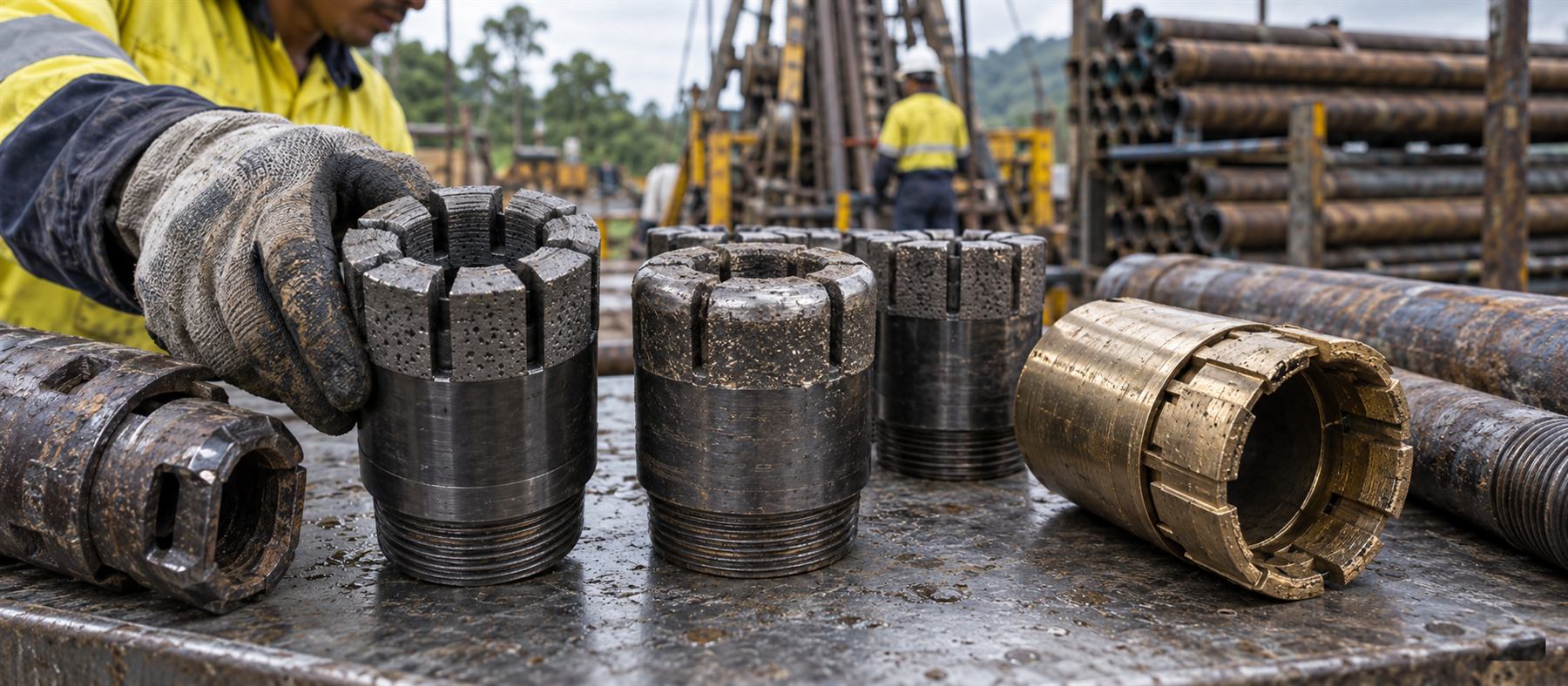
A bit that is wrong for the ground does not usually fail dramatically. It just quietly drills half the metres it should, at two-thirds the penetration rate, and the cost lands on the program rather than on the invoice. Here is how to pick the right one, and how to read the one you just pulled.
How an impregnated bit actually cuts
An impregnated bit has no fixed cutting edge. Diamond grit is distributed all the way through the metal matrix of the crown, and the bit only cuts while that matrix is wearing away fast enough to keep exposing fresh, sharp diamond. Every selection decision below follows from that one fact.
Surface-set bits — natural stones set into the face of the crown — behave differently and belong in soft, non-abrasive formations. Most exploration programs run impregnated, and the rest of this guide is about those.
The rule that runs backwards
Matrix hardness is matched inversely to the ground. This catches people out constantly, because the intuition — hard rock, hard bit — is exactly wrong.
- Hard, non-abrasive rock wants a soft matrix. The formation will not erode the crown on its own, so the matrix has to be soft enough to wear back and release new diamond. Put a hard matrix into hard ground and the bit polishes: it stops cutting and starts rubbing.
- Soft, abrasive rock wants a hard matrix. Abrasive ground scours the crown away quickly. A hard matrix resists that washout and holds its diamonds long enough for the bit to pay for itself.
- Broken, blocky or interbedded ground is a compromise, and it should be made in favour of the hardest interval you expect to drill through rather than the average of the log.
Matrix numbers are not an industry standard
Most manufacturers publish a numbered series where a lower number is a softer matrix, but the scales are their own. One maker’s 6 is not another maker’s 6. When you switch supplier, cross-reference against that maker’s chart rather than carrying the number across.
Grit size, concentration and waterways
Matrix is the first lever. Two more sit behind it, and they trade penetration rate against bit life in opposite directions.
- Coarser grit at lower concentration cuts faster and wears out sooner. Reach for it in medium ground, or when metres per shift is the binding constraint.
- Finer grit at higher concentration cuts slower and lasts longer. Reach for it in hard, competent rock, and in deep holes where a round trip costs more than the bit does.
- Waterway design controls flushing and cooling. Face-discharge crowns put fluid where the cutting happens and suit broken or soft ground; conventional waterways suit competent rock. A bit starved of flush will polish no matter how well the matrix is chosen.
Reading a worn bit
The bit you just pulled is the best data you have about the next one. Look at it before it goes in the bin.
| What you see | What it usually means | What to change |
|---|---|---|
| Penetration rate falls away; crown is shiny and smooth to the touch | The bit is polished — matrix too hard for this ground | Sharpen with an abrasive stick, raise weight on bit, drop RPM. Order the next one a step softer. |
| Crown wears out fast and loses gauge early | Matrix too soft, or the ground is more abrasive than the log suggested | A step harder. Also check the flush is not being over-pumped. |
| Crown cracked, or a segment missing | Mechanical damage — dropped onto the core stub, run into a blocked hole, or excessive weight on bit | This is a practice problem, not a specification problem. Changing matrix will not fix it. |
| Core coming up barrelled or ground down | Poor hole cleaning, or the gauge is gone | Check flush volume and annular clearance; retire the bit. |
| Bit balling up in sticky ground | Formation, not matrix | Treat it in the fluid with a detergent — see the drilling fluid guide. |
| Heavy wear on the inside gauge only | Reaming shell worn out or not run | Replace the shell with the bit, as a set. |
The bit is only half the setup
A correctly specified bit will still underperform if the rig is run wrong, and the failure looks identical to a selection error. Before changing the order, check the three parameters that interact with matrix choice.
- Weight on bit too low is the most common cause of polishing in hard ground. The matrix needs load to wear.
- RPM too high with insufficient load generates heat and glazes the crown; too low gives up penetration for nothing.
- Flush volume has to clear cuttings from the face and cool the crown, without eroding the matrix. Both too little and far too much show up as premature wear.
Hole and core sizes
Standard wireline series, for specifying the bit and the rest of the string together.
| Series | Hole diameter | Core diameter |
|---|---|---|
| BQ | 60.0 mm | 36.5 mm |
| NQ | 75.7 mm | 47.6 mm |
| HQ | 96.0 mm | 63.5 mm |
| PQ | 122.6 mm | 85.0 mm |
Triple-tube variants such as NQ3 and HQ3 return a slightly smaller core in the same hole, and are worth the change in broken ground where recovery matters more than diameter.
Buy metres, not bits
Bit price is the wrong number to compare. The number that matters is cost per metre drilled, and it moves further than the price does: a bit that costs sixty per cent more and drills three times the metres is well under half the price per metre of the cheap one.
Then add the cost the invoice never shows. Every bit change is a round trip — an hour or several, depending on depth, during which the rig makes no metres and the crew is still on shift. In a deep hole the tripping time saved by a longer-lived bit is usually worth more than the bit itself.
What to tell your supplier
A bit recommendation is only as good as the description of the ground. Have this ready and the conversation takes one call instead of three.
- Hole series and whether you are running double or triple tube.
- Formation: rock types, expected strength, how abrasive, and how broken.
- Rig make and model, and the weight on bit and RPM it can actually deliver.
- Flush type and pump capacity.
- Hole depth and inclination, and the recovery the program needs.
- How the last bits performed — metres drilled and why each one came out.
Send us the worn bit
Or at least a photograph of the crown and the gauge. Five minutes looking at a used bit tells us more than a page of formation description, and it is the fastest way to get the next order right.
Related in the catalogue